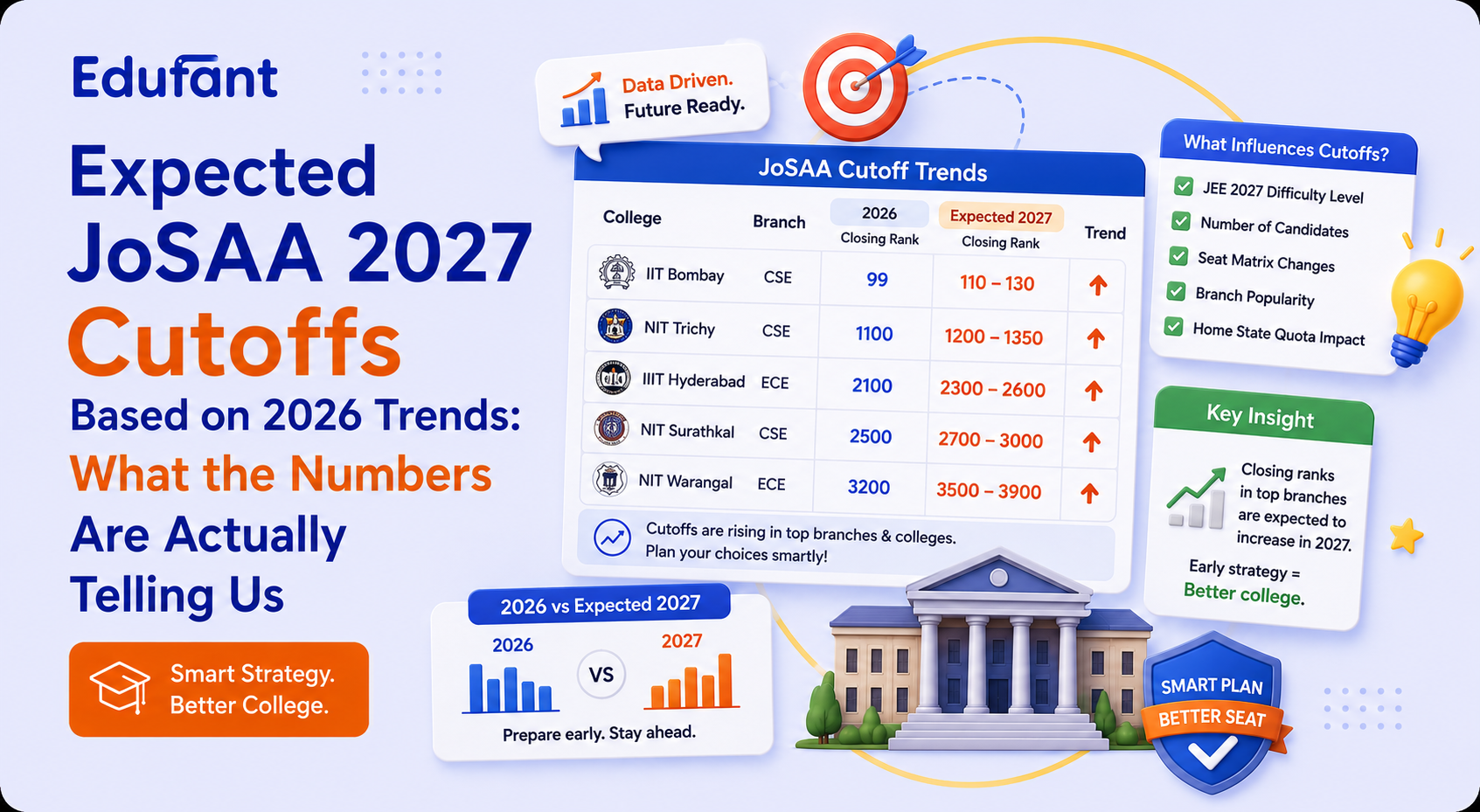
Expected JoSAA 2027 Cutoffs Based on 2026 Trends: What the Numbers Are Actually Telling Us
So your kid just finished JEE Main, or maybe you're the one who took the exam, and now everyone around you is talking about "cutoffs" like it's a number tattooed on a wall somewhere. It's not. It moves every single year, and 2027 is going to move too — just maybe not in the direction you're assuming.
Let's slow down for a second. Grab a coffee. I'll walk you through what 2026 actually showed us, and what that means for the rank you'll need next year. No spreadsheets thrown at your face, promise.
Table of Contents
-
Why You Can't Just Google "JoSAA Cutoff" and Trust It
-
What Actually Happened in JoSAA 2026
-
The Branches Getting Crushed (and the Ones Quietly Loosening)
-
Home State vs Other State — Nobody Explains This Properly
-
So What Will 2027 Actually Look Like?
-
How to Use a College Predictor Without Getting Fooled by It
-
Why Edufant
-
Conclusion
-
FAQs
Why You Can't Just Google "JoSAA Cutoff" and Trust It
Here's the thing nobody tells you upfront. A "cutoff" isn't one number. It's basically hundreds of tiny numbers — one for every single combination of institute, branch, category, quota, and gender. NIT Trichy CSE has its own cutoff. NIT Trichy Civil has a totally different one. Home State and Other State? Different again.
So when your cousin says "bhai, NIT Surathkal CSE band toh 1200 hai," ask him — which year, which round, which category, which quota. Half the time he's quoting Round 1 numbers and acting like that's the final word. It's not. Round 1 is always tighter than the final round. Always.
This is honestly where most students go wrong. Not because they're bad at planning. Because they're comparing apples to a slightly different fruit that just looks like an apple.
What Actually Happened in JoSAA 2026
Okay, real numbers now. JoSAA 2026 had close to 1,79,694 candidates appear for Advanced, and around 56,880 qualified. That's actually a bit more than the year before. More qualifiers chasing largely the same number of seats — you don't need an economics degree to know what that does to competition.
NIT Trichy's CSE cutoff, just for context, has gone from 940 back in 2022 to something around 680 in the very first round of 2026. That's a tightening of 260 ranks over five years. Surathkal moved by roughly 360. Warangal by about 490. These aren't small wobbles — that's a steady, year-on-year squeeze.
And it's not random. It's the sub-2,000 rank band getting more and more crowded, every single cycle.
Here's a fun (read: mildly stressful) fact — the closing rank that you see in Round 1 is genuinely not the one that matters most. By the time Round 5 or Round 6 rolls around, ranks at top NITs usually loosen by another 100 to 300 spots. Why? Because the toppers who got in at Round 1 eventually upgrade out — usually to an IIT seat — and that frees up space below them. It's basically musical chairs, except some people leave the game entirely.
The Branches Getting Crushed (and the Ones Quietly Loosening)
CSE is still the heavyweight champion of "everyone wants this." No surprise there. But 2026 added a twist — Artificial Intelligence and Data Science programs saw a genuinely sharp jump in demand compared to the year before. We're talking real competition for seats that, two or three years ago, weren't even on most students' radar.
Meanwhile — and this part rarely gets said out loud — core branches like Civil and Mechanical have stayed fairly relaxed. Not "easy," but relaxed enough that a student obsessing only over CSE might be missing a genuinely strong option in a branch nobody's hyping up on Instagram.
There's also this odd ripple effect worth knowing. IIT Hyderabad, for instance, has been closing faster than people expect — basically newer IITs eating into the demand that used to flow purely toward the older, more "famous" ones. It tells you something simple: prestige isn't static. It moves.
Home State vs Other State — Nobody Explains This Properly
This one trips up a shocking number of families. NITs reserve half their seats for Home State candidates and half for Other State. And the gap between these two lists isn't small — we're talking anywhere from 10,000 to 30,000 ranks of difference in some cases.
Meaning: a student from, say, Tamil Nadu applying to NIT Trichy under Home State quota might get in at a rank that would get laughed out of the Other State list for the exact same branch. It's not unfair, it's just structurally different — and it's the single most overlooked variable when families build their choice list.
If you're filling your JoSAA choices and you haven't separated Home State numbers from Other State numbers in your head, stop. Go back. Check again.
So What Will 2027 Actually Look Like?
I'm not going to pretend anyone can hand you an exact number for next year. Nobody can — not me, not any "expert," because JoSAA cutoffs are a live outcome of that year's exam difficulty, total qualifiers, and seat matrix changes. They literally don't exist until the counselling actually happens.
But trends? Trends we can actually read.
Based on what 2026 showed — more qualifiers, tighter CSE bands at top NITs, AI and Data Science rising fast, core branches staying relatively calm — here's the honest, no-fluff expectation for 2027:
-
Top-15 NIT CSE seats will likely tighten further, somewhere in the 5–10% range tighter than 2026's final numbers. Not explosive, but consistent — the same direction it's moved every year recently.
-
AI and Data Science programs across NITs and IIITs are probably going to keep climbing in demand. If 2026 was the year this trend became obvious, 2027 is the year it becomes "normal."
-
Core branches (Civil, Mechanical, Chemical) should stay roughly where they are, maybe even loosen slightly if seat matrices expand, which they sometimes do for newer GFTIs.
-
Round 1 to final round gap will likely behave the same way it always does — expect Round 1 numbers to look scarier than they end up being by Round 5 or 6.
A safe general rule, and this comes from looking at year-on-year shifts rather than guessing: add a 5–10% buffer to whatever the 2026 final-round closing rank was, and treat that as your realistic target zone for 2027. Not gospel. A working estimate.
How to Use a College Predictor Without Getting Fooled by It
Quick honest moment here. A lot of students treat a college predictor like it's handing down a verdict from the sky. It's not. It's pattern-matching against years and years of actual closing rank history — which is genuinely useful, but only if the data underneath it is deep enough to mean something.
A college predictor built on one or two years of data is basically guessing with extra confidence. One built on, say, eight years across NITs, IIITs, and GFTIs? That's a very different animal — it's seen the wobbles, the AI-branch surge, the Home State gaps, all of it.
The smart way to use any college predictor is to run your rank through it, then sanity-check the result against what you now know about trends — tightening CSE, rising AI demand, relaxed core branches. If the predictor's output lines up with the direction things are actually moving, you can trust it more. If it feels wildly off from the trend, dig deeper before you build your whole choice list around it.
Why Edufant
Honestly, this is exactly the gap Edufant was built to close. It's not a generic rank calculator someone built over a weekend — it runs on 8 years of real closing rank data across NITs, IIITs, and GFTIs, which means it's actually seen the kind of year-on-year tightening we just talked about, not guessing at it from scratch.
The college predictor inside Edufant doesn't just spit out one number and walk away. It helps you build out a complete, data-backed JoSAA strategy — your safe choices, your realistic ones, your reach options — based on patterns that have actually played out across real counselling cycles, not a single snapshot year that might've been an outlier.
If you're the kind of student (or parent) who wants to go into JoSAA with an actual strategy instead of a prayer and a WhatsApp forward, that's really the whole point of the tool.
Conclusion
Look, nobody can hand you the exact JoSAA 2027 cutoff today — that number doesn't exist yet, and anyone claiming otherwise is selling you something. What you can do is read the trend lines properly: CSE tightening a little more each year, AI and Data Science becoming the new battleground, core branches staying steady, and Round 1 numbers always looking scarier than they end up being.
Use that. Build a choice list with a safe zone, a realistic zone, and a couple of reach options. Run your numbers through a solid college predictor, then double-check it against the direction things are actually moving. That combination — data plus a bit of common sense — is genuinely the best prep you can walk into JoSAA 2027 with.
FAQs
1. Will JoSAA 2027 cutoffs definitely be tighter than 2026?
For the most competitive branches at top institutes — CSE especially, and increasingly AI and Data Science — yes, that's the likely direction based on the last few years. But it's not universal. Core branches and some newer GFTIs could stay flat or even loosen a bit if seat numbers go up.
2. How much buffer should I add to 2026's closing rank for my 2027 planning?
A 5–10% buffer on the final-round (not Round 1) closing rank is a reasonable working estimate for most top NITs and IIITs. It's not exact, but it keeps you from planning around an unrealistically optimistic number.
3. Is a college predictor actually reliable, or is it just a fancy guess?
It's reliable in proportion to how much real historical data it's built on. A predictor trained on a single year is basically a guess with confidence. One built on multiple years across institute types — which is what you want — gives you something genuinely closer to a pattern than a coin flip.
4. Why does Round 1 closing rank look so much tighter than the final round?
Because top-rank students who get a Round 1 seat often upgrade later — usually into an IIT — which frees up the seat below them. By the time you hit Round 5 or 6, that seat's gone to someone with a slightly higher (less competitive) rank. It's not a glitch, it's just how the rounds work.
5. Should I only focus on CSE since it's the most competitive and "best" branch?
Not necessarily. CSE gets all the attention, but core branches like Mechanical and Civil at strong institutes can offer solid outcomes with far less rank pressure. Sometimes the smarter strategic move is the branch nobody's talking about, not the one everyone's fighting over.
0 comments
Loading comments…