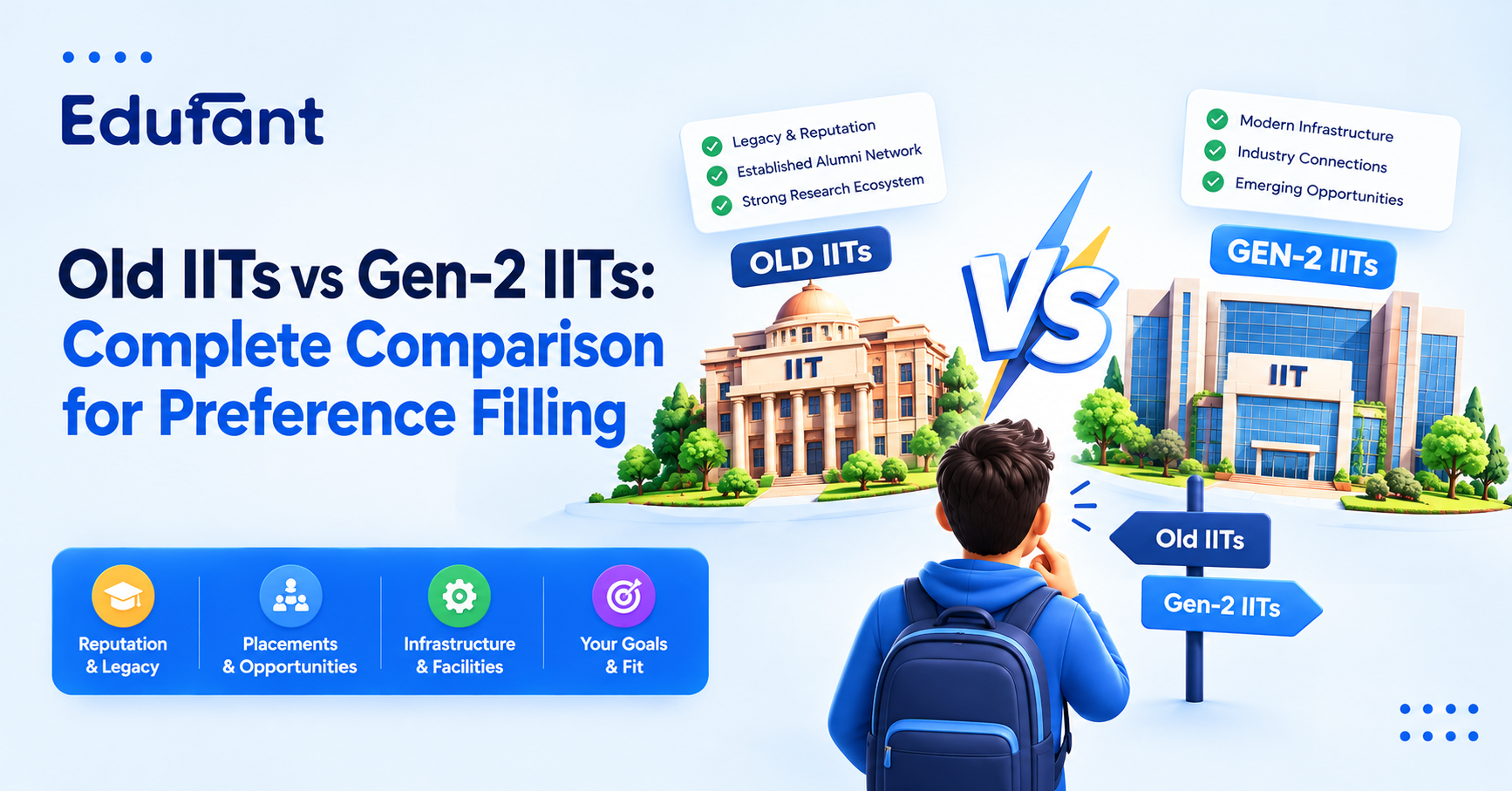
Old IITs vs Gen-2 IITs: Complete Comparison for Preference Filling
So you’ve cracked JEE Advanced. Congratulations, seriously. That’s no small feat. But now comes the tricky part: filling your preference list. And right at the top of your mind is this question—should you go for an old IIT or a Gen-2 one. Here’s the thing both have their strengths. Old IITs like Bombay, Delhi, and Madras have decades of legacy, alumni networks, and brand value. Gen-2 IITs like Indore, Hyderabad, and Gandhinagar are newer, but they’re catching up fast with modern infrastructure and strong industry ties. The real question isn’t which is “better.” It’s which is better for you. And that’s where a good jee main rank predictor (or rather, a JEE Advanced rank analyzer) comes in—it shows you real closing ranks, not just hype.
Table of Contents
-
What Counts as “Old” vs “Gen-2” IITs?
-
Placement Stats: Who’s Hiring, and How Much?
-
CSE Showdown: Old IITs’ Dominance vs Gen-2’s Rise
-
Core Branches: Where Each Group Shines
-
Cutoff Trends: What Rank Do You Actually Need?
-
Campus Life, Location, and Infrastructure: The Real Deal
-
Faculty, Research, and Higher Studies: Behind the Scenes
-
Alumni Network & Brand Value: Long-Term Edge
-
How to Decide: A Simple Framework for Preference Filling
-
Why Edufant Makes This Easier
-
Common Mistakes Students Make When Comparing IITs
-
Final Thoughts: It’s Not About “Better”—It’s About “Right for You”
-
FAQs
What Counts as “Old” vs “Gen-2” IITs?
Let’s start with the basics. The “old” IITs are the first seven: Bombay (1958), Delhi (1963), Madras (1959), Kanpur (1960), Kharagpur (1951), Roorkee (1847, became IIT in 2001), and Guwahati (1995). These are the ones everyone knows. They’ve been around for decades. They’ve built massive alumni networks. And they’ve got the brand recognition to match.
Gen-2 IITs came next: Indore, Hyderabad, Gandhinagar, Ropar, Patna, and Bhubaneswar (all established between 2008–2009). They’re not “new” anymore—they’re nearly 20 years old. But they’re still building their reputation compared to the old guard.
Then there are Gen-3 and Gen-4 IITs (Jodhpur, Mandi, Palakkad, Jammu, etc.), but we’re not covering those here. Today, it’s just old vs Gen-2.
Placement Stats: Who’s Hiring, and How Much?
Alright, let’s talk money. Because at the end of the day, placements matter.
Old IITs (2025–26 data):
-
IIT Bombay: Average package ₹30–32 LPA, highest ₹3 Cr+ (international), 95%+ placed
-
IIT Delhi: Average ₹25–30 LPA, highest ₹2 Cr+, 90%+ placed
-
IIT Madras: Average ₹26–28 LPA, highest ₹1.5 Cr+, 92%+ placed
-
IIT Kanpur: Average ₹28–30 LPA, highest ₹1.8 Cr+, 90%+ placed
-
IIT Kharagpur: Average ₹22–25 LPA, highest ₹2 Cr+, 90%+ placed
-
IIT Roorkee: Average ₹16–18 LPA, highest ₹80 LPA–1 Cr, 88%+ placed
-
IIT Guwahati: Average ₹18–22 LPA, highest ₹60–80 LPA, 85%+ placed
Gen-2 IITs (2025–26 data):
-
IIT Indore: Average ₹18–22 LPA, highest ₹50–60 LPA, 85%+ placed
-
IIT Hyderabad: Average ₹20–24 LPA, highest ₹60–70 LPA, 88%+ placed
-
IIT Gandhinagar: Average ₹16–20 LPA, highest ₹50–55 LPA, 80%+ placed
-
IIT Ropar: Average ₹14–18 LPA, highest ₹45–50 LPA, 78%+ placed
-
IIT Patna: Average ₹12–16 LPA, highest ₹40–45 LPA, 75%+ placed
-
IIT Bhubaneswar: Average ₹14–18 LPA, highest ₹45–50 LPA, 80%+ placed
So what’s the takeaway? Old IITs still lead in average packages and highest offers. But Gen-2 IITs like Hyderabad and Indore are closing the gap—especially in CSE. If you’re in a core branch, old IITs have a clearer edge. If you’re in CSE, Gen-2 IITs are becoming competitive.
CSE Showdown: Old IITs’ Dominance vs Gen-2’s Rise
Let’s zoom in on CSE—the branch everyone cares about.
Old IITs dominate the top of the food chain. IIT Bombay’s CSE average is ₹30–32 LPA. IIT Delhi and Kanpur hover around ₹28–30 LPA. Even IIT Roorkee and Guwahati pull in ₹18–22 LPA on average. Recruiters like Microsoft, Google, Qualcomm, and Goldman Sachs actively target these campuses.
Gen-2 IITs? They’re catching up. IIT Hyderabad’s CSE average is ₹20–24 LPA. IIT Indore is at ₹18–22 LPA. Recruiters include Amazon, Adobe, Flipkart, and startups. The highest offers at Gen-2 IITs touch ₹60–70 LPA, which is impressive—but still below the ₹1–3 Cr+ packages at old IITs.
Here’s the nuance: old IITs have higher peaks (₹3 Cr vs ₹70 LPA). But Gen-2 IITs are more consistent for mid-tier packages. If you’re aiming for top-tier roles, old IITs give you a better shot. If you’re okay with solid, reliable placements, Gen-2 IITs are strong contenders.
Core Branches: Where Each Group Shines
Now, let’s talk core—Electrical, Mechanical, Civil, Chemical, etc.
Old IITs have a clear edge here. IIT Kharagpur’s Mechanical program is legendary. IIT Bombay’s Electrical and Chemical departments are world-class. IIT Madras is known for Aerospace and Civil. These institutes have decades of research output, industry collaborations, and alumni in core sectors.
Gen-2 IITs? They’re still building. Most focus heavily on CSE and ECE. Core branches exist, but placements are modest. Average packages for Mechanical or Civil at Gen-2 IITs hover around ₹8–12 LPA. Old IITs? ₹12–18 LPA for the same branches.
If you’re into core engineering, old IITs are the way to go. Gen-2 IITs are great for CSE/ECE, but they’re not yet competitive in core fields.
Cutoff Trends: What Rank Do You Actually Need?
This is where a jee main rank predictor becomes your best friend. Because cutoffs shift every year, and you need to know where you stand.
Old IITs CSE (General, JEE Advanced AIR):
-
IIT Bombay: ~65–70
-
IIT Delhi: ~100–130
-
IIT Madras: ~120–150
-
IIT Kanpur: ~200–280
-
IIT Kharagpur: ~250–350
-
IIT Roorkee: ~300–400
-
IIT Guwahati: ~400–550
Gen-2 IITs CSE (General, JEE Advanced AIR):
-
IIT Hyderabad: ~400–900
-
IIT Indore: ~900–1,400
-
IIT Gandhinagar: ~1,000–1,600
-
IIT Ropar: ~1,200–1,800
-
IIT Patna: ~1,500–2,200
-
IIT Bhubaneswar: ~1,200–1,800
What does this tell you? Old IITs are significantly more competitive. A rank under 500 gets you CSE at top old IITs. Gen-2 IITs open up from rank 400 onward, with more options as you go down.
And remember: these are approximate. Use a predictor tool to see real-time trends based on your category and preferred branch.
Campus Life, Location, and Infrastructure: The Real Deal
Let’s talk about life outside the classroom. Because you’re not just picking a college—you’re picking a home for four years.
Old IITs:
-
Campus: Large, established, with mature infrastructure. IIT Kharagpur’s campus is 2,100 acres. IIT Madras is a self-contained township.
-
Location: Metro or metro-adjacent. Bombay, Delhi, Madras, Kanpur—all major cities with plenty of internships, startups, and cultural opportunities.
-
Hostels & Mess: Mix of old and new hostels. Mess food varies (some legendary, some… not so much).
-
Fests: Mood IIT (Bombay), Rendezvous (Delhi), Saarang (Madras)—these are national-level fests with big names.
Gen-2 IITs:
-
Campus: Newer, modern, but still expanding. IIT Hyderabad and Indore have sleek, contemporary campuses.
-
Location: Smaller cities or outskirts. Gandhinagar is near Ahmedabad. Ropar is near Chandigarh. Patna and Bhubaneswar are state capitals but less bustling than metros.
-
Hostels & Mess: New hostels with better amenities. Mess food gets mixed reviews (improving every year).
-
Fests: Udgam (Indore), Elan (Hyderabad), Amalthea (Gandhinagar)—growing in scale, but not yet at old IIT levels.
If you love city life and mature campuses, old IITs win. If you prefer modern infrastructure and quieter surroundings, Gen-2 IITs might suit you better.
Faculty, Research, and Higher Studies: Behind the Scenes
Both groups have strong faculty. But there are differences.
Old IITs:
-
Faculty: Mix of seasoned professors and young, research-active faculty. Many have PhDs from top global universities.
-
Research: High output in AI, VLSI, power systems, aerospace, and core engineering. PhD placements are strong.
-
Higher studies: Excellent track record for MS/PhD abroad. CSE and core students regularly get into MIT, Stanford, ETH Zurich, etc.
Gen-2 IITs:
-
Faculty: Younger, more research-focused. Many are early-career professors with strong publication records.
-
Research: Focus on AI, data science, and emerging tech. Core research is growing but not yet at old IIT levels.
-
Higher studies: Good for MS abroad, especially in CSE. Core branches have fewer takers for higher studies.
If you’re into research or higher studies, old IITs have a clearer edge—especially in core fields. Gen-2 IITs are strong for CSE/AI research, but they’re still building in other areas.
Alumni Network & Brand Value: Long-Term Edge
Let’s talk long-term. Because your degree isn’t just about placements—it’s about where it takes you in 10 years.
Old IITs:
-
Alumni: Massive, global network. IIT Bombay alone has 50,000+ alumni working at Google, Microsoft, Goldman Sachs, ISRO, and top startups.
-
Brand value: Instant recognition. “IIT Bombay” or “IIT Delhi” opens doors—even in non-tech fields like finance, consulting, and entrepreneurship.
-
Entrepreneurship: Strong startup ecosystem. IIT Bombay’s SINE, IIT Delhi’s FITT, IIT Madras’ IITM Incubation Cell have launched hundreds of startups.
Gen-2 IITs:
-
Alumni: Smaller, but growing. IIT Hyderabad and Indore have alumni at Amazon, Adobe, and Flipkart.
-
Brand value: Recognized in tech circles, but not yet at old IIT levels. “IIT Hyderabad” is gaining traction, but it doesn’t carry the same weight as “IIT Bombay.”
-
Entrepreneurship: Emerging startup culture. IIT Hyderabad’s T-Hub, IIT Indore’s incubation cell are promising but nascent.
If you’re aiming for long-term brand value and a global network, old IITs win. Gen-2 IITs are building, but they’re not there yet.
How to Decide: A Simple Framework for Preference Filling
Okay, so how do you actually make this call? Here’s a simple framework:
-
Check your rank: Use a jee main rank predictor (or JEE Advanced analyzer) to see which IITs and branches are within reach.
-
Prioritize branch: If you’re set on CSE, compare old vs Gen-2 IIT cutoffs and placements. If you’re into core, lean toward old IITs.
-
Consider location: Do you prefer a metro (Bombay, Delhi) or a quieter city (Indore, Gandhinagar)?
-
Think long-term: Are you aiming for placements, higher studies, or startups? Old IITs have stronger networks for all three.
-
Simulate your choices: Build a mock preference list. See where you’re most likely to get in. Tweak it until you’re confident.
And remember: there’s no “perfect” choice. There’s only the best choice for you.
Why Edufant Makes This Easier
Look, comparing IITs is complicated. There are cutoffs, placements, branches, categories, quotas—it’s a lot. And if you’re trying to decide between old and Gen-2 IITs, you need more than just Google reviews.
That’s where Edufant comes in. It’s not just another college predictor. It’s built on 8 years of real closing rank data across NITs, IIITs, and GFTIs—and now, IITs too. That means you’re not guessing—you’re making decisions based on what actually happened.
Here’s what makes it different:
-
Branch-wise cutoff trends: See how CSE, ECE, and core branches have trended at old vs Gen-2 IITs over 3–5 years.
-
Placement insights: Compare average packages, highest offers, and placement rates for each IIT.
-
Category-specific data: OBC, EWS, SC, ST, PwD, Female—each has different cutoffs. Edufant shows you all of them.
-
Preference simulation: Build your preference list, see your chances, tweak it, and lock it with confidence.
And the best part? It’s designed for students, not consultants. No jargon. No fluff. Just clear, actionable data that helps you make smarter choices.
If you’re serious about JoSAA, you need a jee main rank predictor that actually works. Edufant isn’t perfect—but it’s the closest thing to having a counselor in your pocket.
Common Mistakes Students Make When Comparing IITs
Alright, let’s talk about the traps. Because trust me, everyone falls into at least one of these:
-
Focusing only on average package: A high average doesn’t mean everyone gets placed. Check placement rates too.
-
Ignoring branch strength: A top IIT might be weak in your branch. Always compare branch-wise, not just institute-wise.
-
Overlooking location: City life, weather, and internship opportunities matter. Don’t pick an IIT just because it’s “ranked higher.”
-
Not using category-specific data: Your cutoff depends on your category, gender, and quota. Always filter accordingly.
-
Skipping mock simulations: If you’re not testing your preference list, you’re guessing. And guessing in JoSAA is risky.
The fix? Slow down. Do your research. Use data. And don’t be afraid to pick the IIT that feels right—even if it’s not the “most popular” one.
Final Thoughts: It’s Not About “Better”—It’s About “Right for You”
Here’s the bottom line: old IITs and Gen-2 IITs are both solid choices. Neither is objectively “better.” It depends on what you want.
If you’re aiming for top CSE packages and don’t mind the competition, old IITs might be your pick. If you want modern infrastructure and a slightly lower cutoff, Gen-2 IITs could be the one. If you’re into core engineering, old IITs have a clear edge. If you’re into AI/data science, Gen-2 IITs like Hyderabad are strong contenders.
But here’s the thing: you can’t make this decision in a vacuum. You need data. You need trends. You need to know where you stand with your rank. That’s where tools like Edufant come in. They don’t make the decision for you—but they give you the clarity to decide confidently.
So take your time. Compare the stats. Talk to seniors. And trust yourself. You’ve got this.
FAQs
1. Which is better for CSE: old IITs or Gen-2 IITs?
Old IITs still lead in average packages (₹28–32 LPA vs ₹18–24 LPA) and highest offers (₹1–3 Cr vs ₹50–70 LPA). But Gen-2 IITs like Hyderabad and Indore are catching up. If you’re aiming for top salaries, old IITs edge out. If you want solid placements with slightly lower cutoffs, Gen-2 IITs are strong.
2. What rank do I need for CSE at old IITs vs Gen-2 IITs?
For General category (JEE Advanced AIR):
-
Old IITs (Bombay, Delhi, Madras): ~65–150
-
Old IITs (Kanpur, Kharagpur, Roorkee): ~200–400
-
Gen-2 IITs (Hyderabad, Indore): ~400–1,400
Use a jee main rank predictor to see real-time cutoffs based on your category.
3. Are Gen-2 IITs good for core branches like Mechanical or Electrical?
Not yet. Old IITs dominate core placements (₹12–18 LPA average). Gen-2 IITs focus heavily on CSE/ECE, with core branches averaging ₹8–12 LPA. If you’re into core engineering, old IITs are the way to go.
4. How’s campus life at old IITs vs Gen-2 IITs?
Old IITs have large, mature campuses in metro cities with national-level fests. Gen-2 IITs have newer, modern campuses in smaller cities with growing fests. If you love city hustle, pick old IITs. If you prefer calm and modern infrastructure, pick Gen-2 IITs.
5. Can I use Edufant to compare these IITs?
Absolutely. Edufant shows you branch-wise cutoff trends, placement stats, and category-specific data for both old and Gen-2 IITs. You can simulate your preferences and see your chances before locking your list. It’s basically your personal JoSAA strategist.
0 comments
Loading comments…