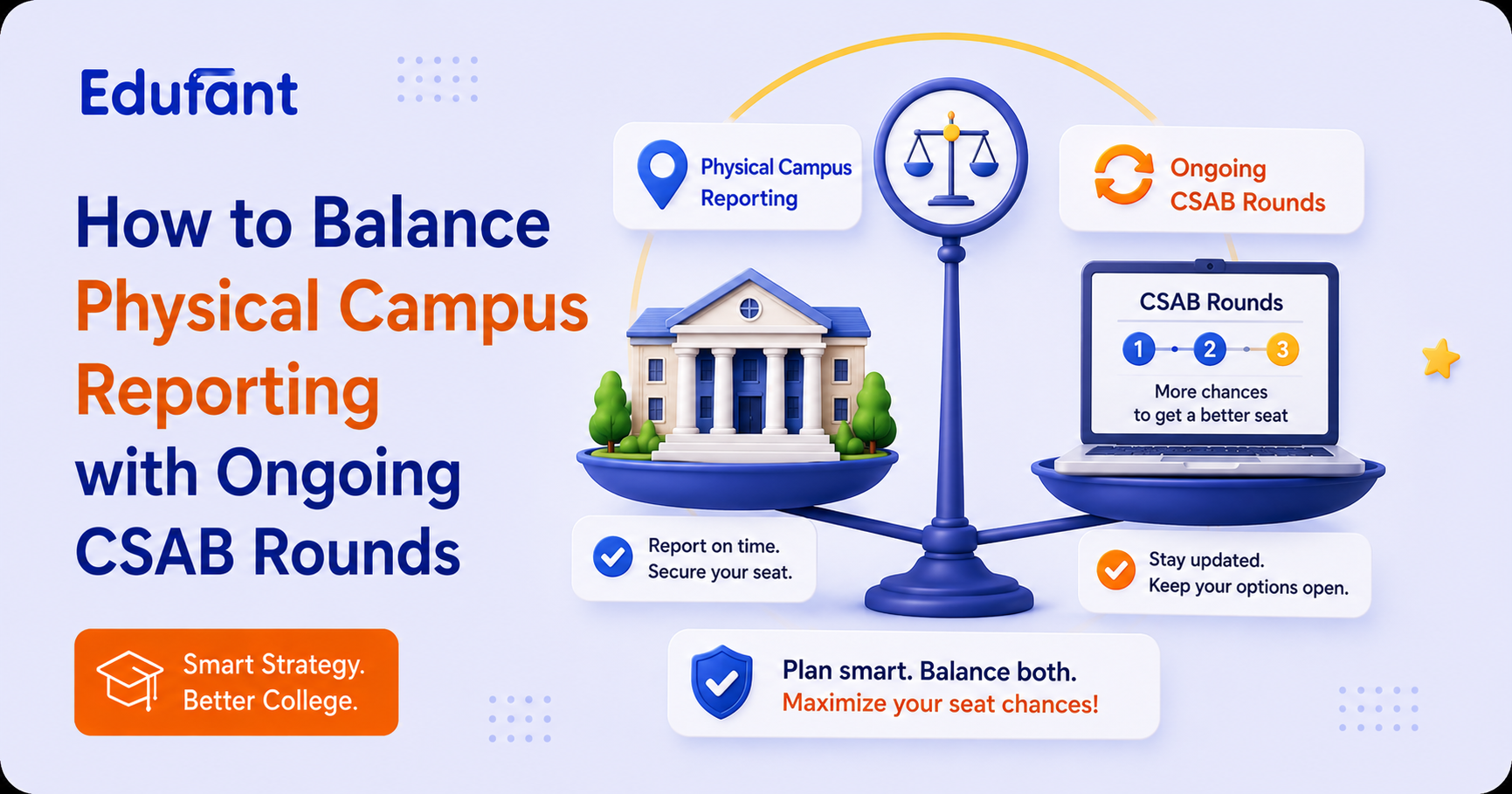
How to Balance Physical Campus Reporting with Ongoing CSAB Rounds
So you’ve got a seat. Maybe it’s from JoSAA Round 5. Maybe it’s from a CSAB special round after using a JoSAA college predictor to gauge your chances. Either way, you’re staring at two deadlines: one says “report to campus by August 18,” and the other says “wait for CSAB Round 2 results.” And now you’re stuck. Do you report? Do you wait? What if you lose your seat? Here’s the thing: you’re not alone. A lot of students face this exact dilemma every year. The good news? It’s manageable. You just need to understand the rules, plan your moves, and not panic. That’s exactly what we’re breaking down today—step by step, in plain English.
Table of Contents
-
What’s the Difference Between JoSAA and CSAB?
-
Why Physical Reporting Matters (And Why You Can’t Skip It)
-
The CSAB Special Rounds: Your Second (or Third) Chance
-
Can You Do Both? Reporting + CSAB Participation
-
The Risk of Waiting: What Happens If You Delay Reporting
-
How to Decide: Report Now or Wait for CSAB?
-
Smart Strategies to Balance Both Without Losing Your Seat
-
Documents, Fees, and Deadlines: What You Actually Need
-
Why Edufant Makes This Easier
-
Common Mistakes Students Make (And How to Avoid Them)
-
Final Thoughts: Play It Smart, Not Scared
-
FAQs
What’s the Difference Between JoSAA and CSAB?
Let’s start with the basics. JoSAA (Joint Seat Allocation Authority) handles admissions to IITs, NITs, IIITs, and GFTIs through five main rounds. Once those five rounds wrap up, CSAB (Central Seat Allocation Board) steps in to fill any leftover seats—usually through one or two special rounds.
Think of JoSAA as the main event. CSAB is the encore. Same stages (NITs, IIITs, GFTIs), same rules mostly, but separate registration, separate fees, and separate timelines.
Here’s the key point: if you participated in JoSAA, you still need to register fresh for CSAB. Your JoSAA choices don’t carry over. And if you get a seat in CSAB, it replaces your JoSAA seat automatically. So you can’t hold both.
Why Physical Reporting Matters (And Why You Can’t Skip It)
Alright, let’s talk about physical reporting. This isn’t optional. If you’ve been allotted a seat—whether through JoSAA or CSAB—you have to physically report to the institute within the given window. For 2026, that’s roughly August 13 to August 18.
Why? Because the institute needs to verify your original documents, collect your balance fees, and confirm your admission. If you don’t show up, your seat gets cancelled. No refunds. No second chances.
And here’s the kicker: even if you’re waiting for CSAB Round 2 results, you still need to report to your current allotted institute if the deadline is approaching. Otherwise, you risk losing everything.
The CSAB Special Rounds: Your Second (or Third) Chance
CSAB special rounds are for students who either didn’t get a seat in JoSAA or want to upgrade to a better option. There are usually two rounds: Special Round 1 and Special Round 2.
In Special Round 1, you register, fill choices, and get an allotment. But here’s the twist: you don’t physically report after Round 1. You just pay the Institute Admission Fee-II (IAF-II) online and upload your documents. Physical reporting happens only after Special Round 2 concludes.
That’s important. It means if you’re in CSAB Round 1, you’ve got some breathing room. But if you’re in Round 2, you need to report physically ASAP—usually within 5–6 days of the result.
Can You Do Both? Reporting + CSAB Participation
This is the million-dollar question. And the answer is: yes, but with conditions.
If you already have a JoSAA seat and you register for CSAB, you can still participate. If CSAB allots you a new seat, your JoSAA seat gets cancelled automatically. If CSAB doesn’t allot you anything, you keep your JoSAA seat.
But here’s where it gets tricky: if your JoSAA reporting deadline is before CSAB Round 2 results, you need to report to your JoSAA institute first. Otherwise, you lose that seat. And if CSAB later allots you something, you can always withdraw from the JoSAA institute and join the CSAB one.
So yes, you can do both. But you need to time it right.
The Risk of Waiting: What Happens If You Delay Reporting
Let’s be real: waiting feels safer. You hope CSAB Round 2 gives you a better option. But here’s the risk: if you miss your physical reporting deadline, your current seat is gone. Poof. No take-backs.
And CSAB doesn’t guarantee anything. Maybe Round 2 won’t allot you a seat. Maybe the seats left aren’t what you wanted. Now you’re stuck with nothing.
That’s why the golden rule is: never let your current seat expire while waiting for a better one. Report first. Upgrade later if you can.
How to Decide: Report Now or Wait for CSAB?
Okay, so how do you actually make this call? Here’s a simple framework:
-
If your reporting deadline is before CSAB Round 2 results: Report to your current institute. Don’t gamble.
-
If you’re confident CSAB will give you a significantly better option: Still report now, but keep your documents ready to withdraw later if needed.
-
If your current seat is already what you wanted: Skip CSAB. Save the fees, save the stress.
-
If you’re unsure: Use data. Look at past CSAB seat matrices. See what branches and colleges usually come up in Round 2. That’ll tell you if waiting is worth it.
And here’s a pro tip: talk to seniors or use platforms like Edufant to see real trends. Don’t base your decision on rumors or WhatsApp forwards.
Smart Strategies to Balance Both Without Losing Your Seat
Alright, let’s get tactical. Here’s how to play this smart:
-
Report to your current institute on time. Even if you’re waiting for CSAB, secure your seat first.
-
Keep your documents organized. You’ll need originals for reporting, plus photocopies for CSAB uploads.
-
Pay the IAF-II fee for CSAB if you’re participating. It’s refundable if you don’t get a seat, but mandatory if you do.
-
Monitor CSAB results daily. Round 2 results can drop anytime. Don’t miss the window.
-
Know the withdrawal process. If CSAB allots you a better seat, you’ll need to formally withdraw from your current institute. Each college has its own process—check their website.
-
Budget for fees. JoSAA seat acceptance fee is ₹40,000 (General) or ₹20,000 (SC/ST/PwD). CSAB IAF-II is ₹35,000 or ₹16,000. You might need to pay both temporarily.
And remember: this isn’t about perfection. It’s about minimizing risk while maximizing opportunity.
Documents, Fees, and Deadlines: What You Actually Need
Let’s cut through the noise. Here’s what you actually need for physical reporting:
Documents:
-
Seat Allotment Letter (print from portal)
-
JEE Main Admit Card & Rank Card
-
Class 10 & 12 Mark Sheets + Certificates
-
Category Certificate (if applicable)
-
PwD Certificate (if applicable)
-
Passport-size Photos (10–15 copies)
-
ID Proof (Aadhaar, Passport, etc.)
-
Fee Payment Receipts
Fees:
-
JoSAA Seat Acceptance Fee: ₹40,000 (General/OBC-NCL/EWS) or ₹20,000 (SC/ST/PwD)
-
CSAB IAF-II: ₹35,000 (General/OBC-NCL/EWS) or ₹16,000 (SC/ST/PwD)
-
Balance Institute Fee: Varies by college (pay at reporting)
Deadlines (2026 Tentative):
-
CSAB Special Round 1 Online Reporting: August 6–10
-
CSAB Special Round 2 Online Reporting: August 12–14
-
Physical Reporting at Institutes: August 13–18
Always double-check your institute’s website. Some colleges have slightly different dates or additional requirements.
Why Edufant Makes This Easier
Look, JoSAA and CSAB are complicated. There are deadlines, fees, documents, seat matrices, and a million little details that can trip you up. And if you’re trying to balance physical reporting with ongoing CSAB rounds, the pressure’s even higher.
That’s where Edufant comes in. It’s not just another JoSAA college predictor. It’s built on 8 years of real closing rank data across NITs, IIITs, and GFTIs. That means you’re not guessing—you’re making decisions based on what actually happened.
Here’s what makes it different:
-
CSAB seat trend analysis: See which branches and colleges usually come up in CSAB special rounds. Plan your choices accordingly.
-
Deadline tracker: Never miss a reporting or fee payment deadline again.
-
Document checklist: Get a personalized list of what you need for your specific category and institute.
-
Fee calculator: Know exactly how much you’ll need to pay at each stage—JoSAA, CSAB, institute fees, everything.
And the best part? It’s designed for students, not consultants. No jargon. No fluff. Just clear, actionable data that helps you make smarter choices.
If you’re serious about balancing reporting and CSAB, you need a JoSAA college predictor that actually works. Edufant isn’t perfect—but it’s the closest thing to having a counselor in your pocket.
Common Mistakes Students Make (And How to Avoid Them)
Alright, let’s talk about the traps. Because trust me, everyone falls into at least one of these:
-
Waiting for CSAB without reporting: Big mistake. If your reporting deadline passes, you lose your seat. Report first, upgrade later.
-
Not registering fresh for CSAB: Your JoSAA registration doesn’t carry over. You need to register again on csab.nic.in.
-
Missing IAF-II payment: If you get a CSAB seat and don’t pay IAF-II within the window, your seat is cancelled. No exceptions.
-
Assuming all colleges have the same deadline: They don’t. Some institutes report August 13, others August 18. Check your college’s website.
-
Not keeping documents ready: You’ll need originals for reporting and uploads for CSAB. Organize them now, not the night before.
-
Ignoring withdrawal rules: If you switch from JoSAA to CSAB, you need to formally withdraw. Each college has its own process—follow it.
The fix? Slow down. Read the official notifications. Use tools like Edufant to track deadlines and requirements. And don’t panic—this is manageable if you plan smart.
Final Thoughts: Play It Smart, Not Scared
Here’s the bottom line: balancing physical reporting with CSAB rounds isn’t easy. But it’s doable. You just need to understand the rules, plan your moves, and not let fear drive your decisions.
Report to your current seat on time. Keep your options open with CSAB. Use data to decide if waiting is worth it. And don’t gamble with deadlines—secure your seat first, upgrade later if you can.
And remember: you’re not alone in this. Thousands of students face the same dilemma every year. The ones who succeed aren’t the luckiest—they’re the most prepared.
So take a deep breath. Make a checklist. Use the right tools. And trust yourself. You’ve got this.
FAQs
1. Can I participate in CSAB if I already have a JoSAA seat?
Yes. You can register for CSAB even if you have a JoSAA seat. If CSAB allots you a new seat, your JoSAA seat is automatically cancelled. If not, you keep your JoSAA seat.
2. Do I need to report physically after CSAB Special Round 1?
No. Physical reporting happens only after CSAB Special Round 2 concludes. After Round 1, you just pay IAF-II and upload documents online.
3. What if I miss my physical reporting deadline?
Your seat gets cancelled. No refunds. No second chances. Always report on time, even if you’re waiting for CSAB results.
4. Can I withdraw from my JoSAA seat after joining if I get a better CSAB seat?
Yes, but you need to follow your institute’s withdrawal process. Some colleges allow it, others don’t. Check their website or contact the admission office.
5. How do I know if waiting for CSAB is worth it?
Look at past CSAB seat matrices. See which branches and colleges usually come up in Round 2. Use tools like Edufant to analyze trends and make data-backed decisions.
0 comments
Loading comments…