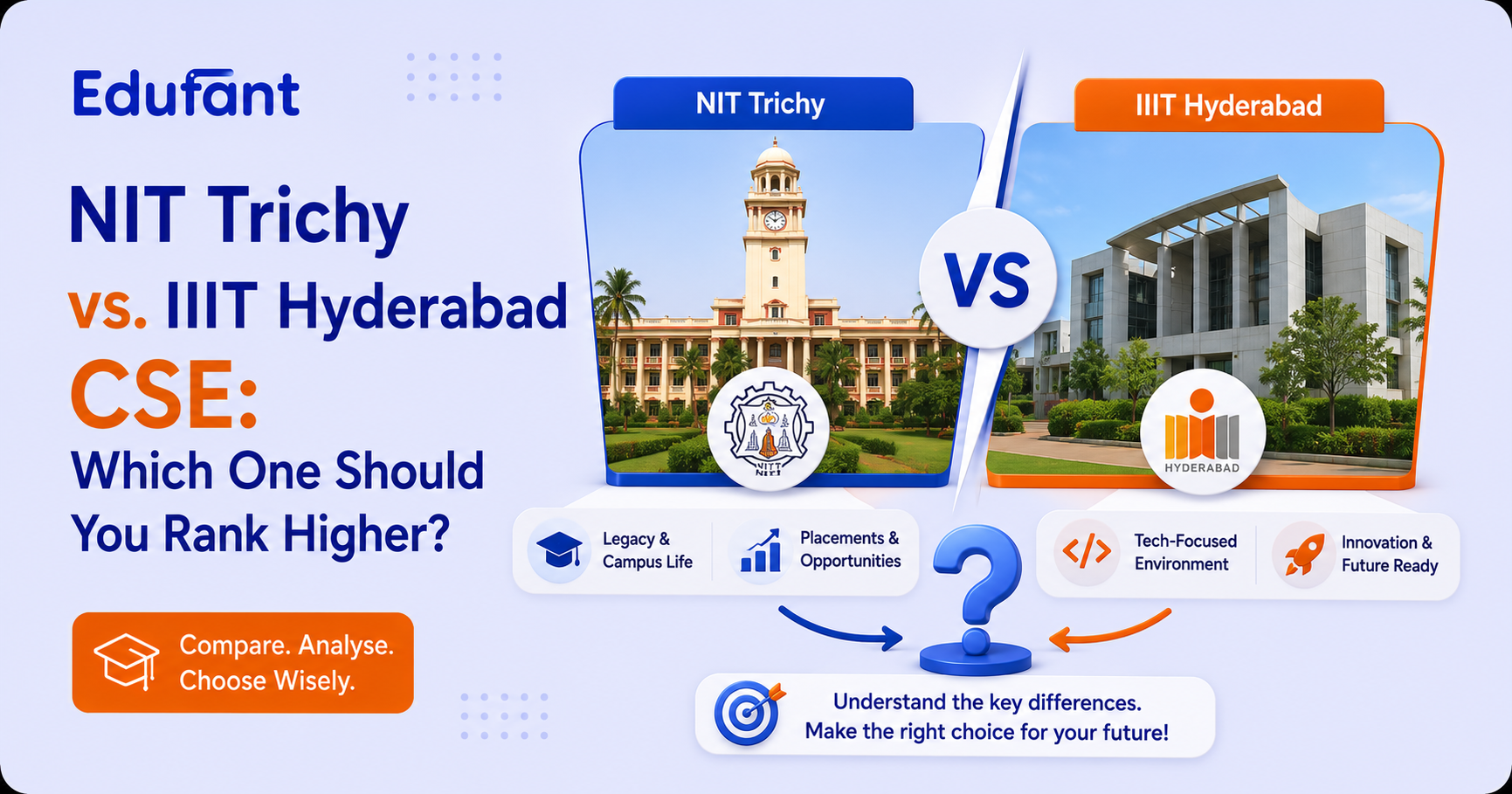
NIT Trichy vs. IIIT Hyderabad CSE: Which One Should You Rank Higher?
So you cracked JEE. Your rank is somewhere in the range where both NIT Trichy CSE and IIIT Hyderabad CSE are on the table. And now you're staring at your JoSAA preference list wondering which one goes higher. This isn't a decision you want to make based on a random YouTube video, a generic college predictor tool, or your neighbour aunty's "gut feeling." Both colleges are genuinely excellent. Both can take you places. But they're built differently, and which one suits you depends on things that aren't obvious at first glance.
This piece tries to break that down honestly. We're talking closing ranks, placements, research culture, campus vibes, fee structures, and the kind of student who tends to thrive at each place. No fluff, no cheerleading for either side. Just a real conversation about a decision that matters a lot.
Table of Contents
-
The Basic Question You Should Actually Be Asking
-
Closing Ranks — What the Data Actually Tells You
-
Placements: The Numbers Everyone Wants First
-
Research Culture and Academics
-
Campus Life and Infrastructure
-
Fee Structure (Yes, It Matters)
-
The Student Type Fit
-
Why Edufant
-
Conclusion
-
FAQs
The Basic Question You Should Actually Be Asking
Most students frame this as "which college is better." That's not really the question. The better question is: better for what?
NIT Trichy is one of the oldest NITs in the country. It's got the brand weight, the alumni network, the infrastructure. When you say "I'm from NIT Trichy," people in the industry know what that means without you needing to explain anything.
IIIT Hyderabad, on the other hand, is a research-first institution. It was literally founded to produce people who don't just write code but think deeply about it. If you want a PhD at a top global university, or you want to work at a research lab, IIIT-H has a very specific kind of edge that NIT Trichy doesn't quite replicate.
So the question isn't which college is "ranked higher." It's what you actually want to do after four years.
Closing Ranks — What the Data Actually Tells You
Let's get into the numbers. These close every year so treat them as directional rather than exact.
NIT Trichy CSE (Home State vs. Other State) tends to have a closing rank somewhere around 1,200–2,500 for general category depending on the year and whether you're a state quota candidate or an OS seat applicant. The variance matters — if you're from Tamil Nadu, you're looking at a different set of numbers than if you're from elsewhere.
IIIT Hyderabad CSE typically closes around 800–1,800 for the general category. It's a smaller intake — around 120–150 seats across its various programmes — and the college has been consistently pulling stronger ranks over the last few years as its research reputation has grown.
The overlap zone is real. If your rank sits somewhere between 1,200 and 1,800, both are potentially within reach depending on category and quota.
One thing that trips a lot of students up: they don't factor in the specific seat type when building their preference list. NIT Trichy has OS (Other State) and HS (Home State) quotas with very different closing ranks. This is exactly the kind of detail you need sorted before you lock in your JoSAA preferences.
Placements: The Numbers Everyone Wants First
Okay, placements. Both colleges do well. But the nature of placements differs.
NIT Trichy CSE has strong product company placements. You'll see offers from Google, Microsoft, Amazon, Goldman Sachs, Uber, and similar. The median salary tends to sit around 18–24 LPA with top offers touching 50 LPA+ in good years. It's a large batch, so the absolute number of high-paying offers is significant, though the percentage might be a bit more variable than the headlines suggest.
IIIT Hyderabad's placement numbers look different — partly because of batch size. Their median for CSE students has historically been strong, often in the 20–30 LPA range with a heavy skew toward product companies and research roles. A non-trivial chunk of IIIT-H students also go directly to grad school (IIMs, top US universities), so the "placement" data doesn't capture the full picture.
If you want a corporate job immediately after B.Tech, both deliver. If you're leaving options open for research or a top MBA, IIIT-H's profile arguably looks stronger.
Research Culture and Academics
This is where the two colleges really split.
IIIT Hyderabad has a dual-degree structure at its core — the B.Tech + MS (Research) is the flagship programme, and the culture of the college is built around it. Professors are actively publishing. Students work in labs from second year onward in many cases. The interaction between undergrads and research is much tighter than at most engineering colleges.
NIT Trichy's academics are rigorous, but it's primarily an undergraduate-teaching focused institution. The research output has grown over the years, but it's not the same environment. If you're someone who wants to spend evenings in a lab or co-author a paper before you graduate, IIIT-H has the ecosystem for it. If that doesn't interest you much and you just want to learn software engineering really well and get placed, NIT Trichy is absolutely fine.
The coursework at IIIT-H can feel intense. Particularly in the first two years. Students who weren't expecting it sometimes find it jarring. NIT Trichy is challenging too, but the nature of the workload is different.
Campus Life and Infrastructure
NIT Trichy is an old campus. Large, sprawling, properly set up. Hostels are functional — not luxury, but reasonable. The sports facilities, clubs, technical fests (Pragyan is genuinely well-regarded), cultural fests — there's a lot going on. It's the kind of place where you'll have memories beyond academics.
IIIT Hyderabad's campus is smaller but well-maintained. Hyderabad as a city is a big plus — it's one of the best cities in India for a tech student. The research labs are well-equipped. The culture on campus tends to be academically intense in a way that's palpable. People are genuinely working on things. But the social scene, by IIIT-H students' own accounts, is quieter compared to something like NIT Trichy.
Neither is a bad place to spend four years. They're just different textures of life.
Fee Structure (Yes, It Matters)
NIT Trichy's annual fees for B.Tech CSE are roughly around 1.25–1.50 lakh per year (excluding hostel). Being a government institution, it's subsidised.
IIIT Hyderabad's fees are higher — roughly 2.5–3 lakh per year, and if you're on the B.Tech + MS programme it stretches out to five years. The total outgo is meaningfully higher.
For families where this difference is significant, it's worth thinking about. Scholarships exist at both institutions and there's a JEE-based scholarship at IIIT-H that can ease the financial burden for top rankers, but don't assume it's automatic.
The Student Type Fit
Here's an honest way to think about it.
Go to IIIT Hyderabad if you're genuinely excited by the idea of research, if you've ever spent time reading a paper out of curiosity rather than compulsion, if you're considering a PhD or want to work at DeepMind or Google Brain type of roles down the line, or if the idea of a tight-knit academic environment appeals to you.
Go to NIT Trichy if you want a broader college experience, a larger and older alumni network, strong campus placements with a lot of companies walking through the door, and a more "typical" but excellent engineering college experience. If you're not sure what you want to do yet, honestly, NIT Trichy gives you a bit more time to figure it out without the research pressure.
There's no wrong answer here as long as you're honest with yourself about which type of student you actually are versus which type you wish you were.
Why Edufant
Here's the thing about JoSAA counseling — everyone has opinions, but opinions aren't data.
When you're building your preference list, you don't just need to know whether IIIT-H or NIT Trichy CSE is "better." You need to know whether your specific rank, category, and quota can actually get you into the seat you're targeting. And if not that seat, which branch at which college is the next best option that doesn't make you regret the choice two years later.
That's exactly what Edufant is built for. It's a college predictor backed by 8 years of real closing rank data across NITs, IIITs, and GFTIs. Not one year's data that might have been a fluke. Not crowd-sourced guesses. Actual JoSAA closing ranks across rounds, so you can see how the numbers have moved historically and what the realistic probability of getting a specific seat is at your rank.
The college predictor on Edufant doesn't just spit out a list and leave you there. It helps you build a preference list strategy — understanding which seats are reaches, which are safe, which branches pair well together, and how round-by-round seat movements could affect your position.
If you're choosing between two top colleges like this, getting that data layer right is the difference between a choice you made confidently and one you made hoping for the best.
Conclusion
NIT Trichy and IIIT Hyderabad are two of the best places to study CSE in India. They're not in competition with each other in any meaningful sense — they've just optimised for different things.
If research and depth matter to you, IIIT-H probably goes higher on your list. If you want placement diversity, a big campus network, and more of a traditional college experience, NIT Trichy probably goes higher.
The honest answer most counselors won't give you: for a lot of students in that 1,200–2,000 rank range, the decision comes down to what feels right after you've looked at the data clearly. And the data part — that's where you shouldn't be guessing.
FAQs
Q1. Is IIIT Hyderabad CSE better than NIT Trichy CSE?
Neither is universally "better." IIIT Hyderabad has a stronger research culture and can be a better fit for students aiming at PhDs or research-heavy roles. NIT Trichy has stronger brand recognition across industries, a larger alumni network, and more campus recruitment variety. For a student who wants to work directly in product companies after graduation, both are excellent — NIT Trichy might edge ahead simply due to company footfall. For someone with strong research interests, IIIT-H is hard to beat.
Q2. What's the closing rank for IIIT Hyderabad CSE in general category?
It varies year to year, but IIIT Hyderabad CSE has historically closed roughly between 800 and 1,800 for the general (open) category. The spread depends on the specific programme (B.Tech vs. B.Tech + MS) and the year's JEE Advanced score distribution. Always check at least 3–4 years of historical data rather than just last year's number — a college predictor tool like Edufant's makes this much easier since it aggregates real round-wise data from multiple years.
Q3. Is the fee difference between NIT Trichy and IIIT Hyderabad significant?
Yes, meaningfully so. NIT Trichy's annual fees are in the range of 1.25–1.50 lakh per year. IIIT Hyderabad is roughly 2.5–3 lakh per year, and the B.Tech + MS programme runs for five years. Over the full degree, the difference can be around 6–8 lakh in total fees. For families where that's a factor, it's worth accounting for in the decision.
Q4. Does IIIT Hyderabad have good campus life?
IIIT-H's campus life is academically intense. Students who thrive there tend to enjoy the research environment and the culture of working on hard problems. Social events exist but the vibe is quieter than larger campuses. The advantage of being in Hyderabad — one of India's best cities for tech — makes up for a lot of that. It's not a party college, and most people there would say that's fine.
Q5. How should I decide where to place NIT Trichy vs. IIIT Hyderabad on my JoSAA list?
Start with honest self-assessment: do you know what you want to do after graduation? If research or a top global grad school is the direction, IIIT-H goes higher. If you're unsure or want the broadest possible industry options, NIT Trichy goes higher. Then verify with actual rank data — look at 3–4 years of closing ranks for both, factor in your category and home state, and identify which seats are realistic vs. aspirational for your rank. A data-backed college predictor that shows historical JoSAA round-wise closing ranks is the cleanest way to avoid making this call based on noise.
0 comments
Loading comments…