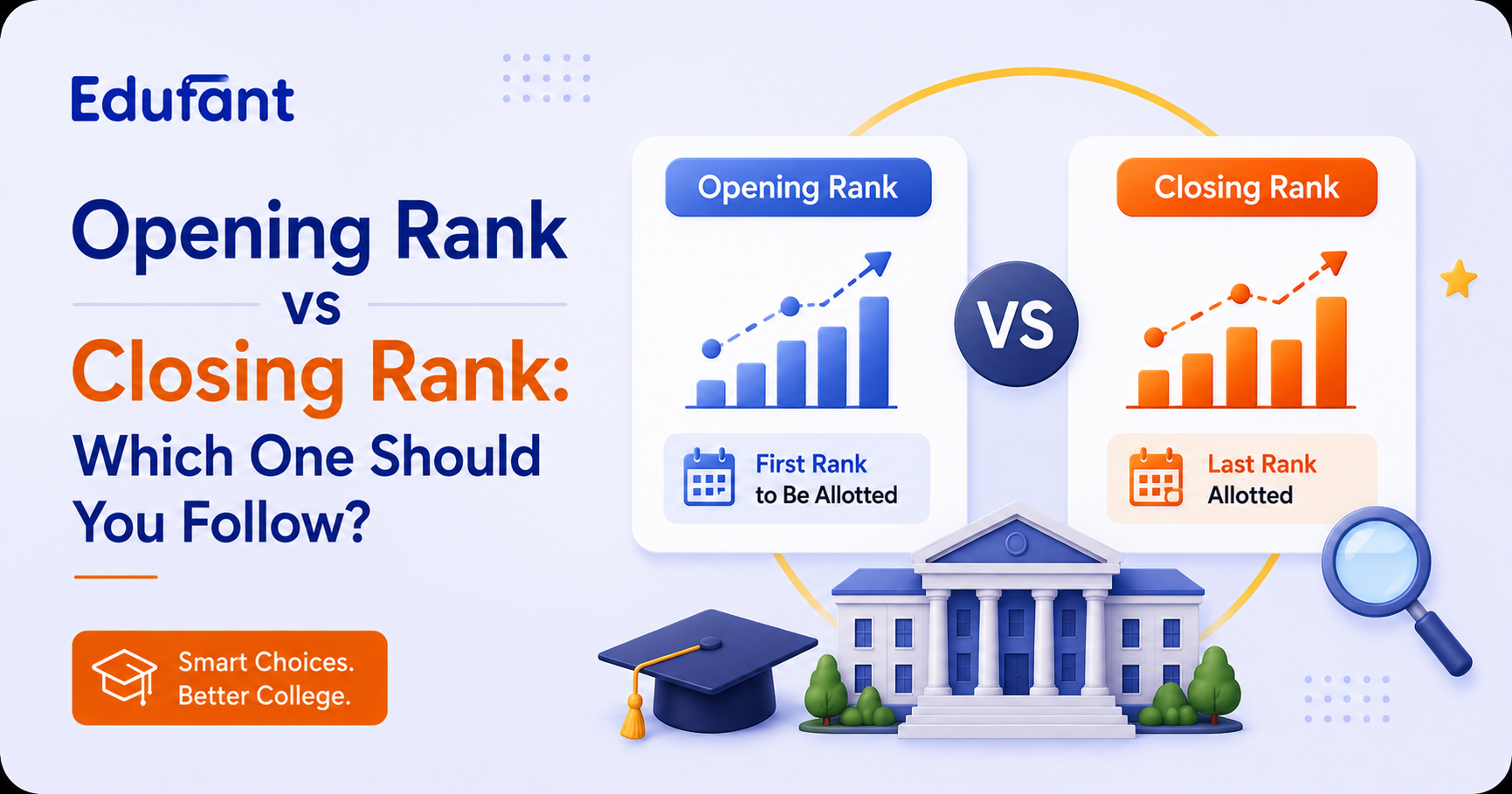
Opening Rank vs Closing Rank: Which One Should You Follow?
So you've cleared JEE. You've got your rank. And now everyone around you is throwing terms like "opening rank," "closing rank," "last year's cutoff" — and somehow you're expected to magically know which choices to fill out. Instead of drowning in endless PDFs and confusing cutoff trends, a reliable jee college predictor can instantly filter the data to match your exact rank with the right institutions.
Here's the thing: most students spend way too much energy staring at the opening rank and completely miss what the closing rank is actually telling them. These two numbers mean very different things, and mixing them up is probably one of the most common reasons students end up with a branch they didn't really want — or worse, don't get a seat at all. Let's slow down and actually make sense of them.
Table of Contents
-
What's the Opening Rank, really?
-
What's the Closing Rank?
-
The difference — and why it matters more than you think
-
Which one should you follow?
-
How many years of data should you look at?
-
Common mistakes students make with these numbers
-
Why Edufant helps you read this data better than a spreadsheet can
-
Conclusion
-
FAQs
What's the Opening Rank, Really?
The opening rank is the rank of the very first student who got a seat in a particular program at a particular institute in a given round of JoSAA counseling.
That's it. First person in.
It sounds useful, but here's where people get confused. If a branch at an NIT had its first seat go to someone with rank 1,200 in 2024, that doesn't mean you need rank 1,200 to get in. It just means one person with that rank chose it early, probably when it was still available in Round 1.
Think of it this way. You're at a concert and the venue has 500 seats. The opening rank is basically the person who sat down first. The closing rank is the last person who got in before the doors shut.
What's the Closing Rank?
The closing rank is the rank of the last student who got a seat in that program before all seats filled up — across all rounds of JoSAA counseling.
This is the number you should care about.
If the closing rank for Computer Science at NIT Trichy (Home State, General) was 4,850 in 2024, that means someone with rank 4,850 got in. Which means anyone ranked better than 4,850 had a real shot at that seat.
The closing rank tells you who actually got the last seat. The opening rank tells you who got the first. For predicting your chances, you want to know about the last seat — not the first.
The Difference and Why It Matters More Than You Think
Here's a real scenario to make this stick.
Say you're looking at Mechanical Engineering at a well-known NIT. The opening rank shows 2,100. The closing rank shows 9,700.
If you have a rank of 7,500 and you're only looking at the opening rank, you'd probably skip this college thinking you're not good enough. But the closing rank is telling you something completely different — someone with rank 9,700 got in. You're well within range.
That's a college you just almost removed from your list based on the wrong number.
The gap between opening and closing can be thousands of ranks. For less popular branches or institutes with many seats, that gap gets even bigger. For the most sought-after programs (CSE at the top NITs, for example), the gap is often quite small — which tells you demand is extremely concentrated.
Which One Should You Follow?
Follow the closing rank. Always.
The opening rank is helpful only in one limited scenario: when you're trying to understand the category of students a program attracts in early rounds, or if you want to know the theoretical best-case rank to lock something in Round 1. That's about it.
For predicting whether you have a chance? Closing rank is your reference point.
But here's the catch — don't just look at one year's closing rank. A single year can be misleading. If a program had an unusually low closing rank in 2023 because fewer students chose it or seats went unfilled, that number might not repeat in 2025.
This is where using a proper jee college predictor actually matters. Instead of manually comparing one year of data and guessing, you want to see trends across multiple years so you can tell if a program is consistently accessible at your rank or if last year was an exception.
How Many Years of Data Should You Look At?
Minimum three years. Ideally five if you can get it.
Why? JoSAA closing ranks fluctuate based on how many students appear that year, how the difficulty of the paper felt, which colleges gained or lost reputation, and random factors you can't predict. A single year is a snapshot. Three to five years is a pattern.
If the closing rank for a program has been between 5,200 and 6,100 for the last four years, and your rank is 5,500 — that's a solid indicator you're in range. If the range was 3,800 to 7,400 across those years, it's more volatile and you'd want to treat it as a reach rather than a safe pick.
Common Mistakes Students Make With These Numbers
Looking only at Round 1 data. JoSAA has multiple rounds. The closing rank after Round 6 is very different from what it looks like after Round 1. Closing rank always refers to the final round, not an intermediate one.
Comparing different categories. Opening and closing ranks vary dramatically across categories — General, OBC-NCL, SC, ST, EWS, PwD. If you're comparing a General closing rank to your rank under a different category, the numbers mean nothing. Always compare within your own category.
Treating one year as gospel. Already covered this, but it's worth repeating because students do it constantly.
Ignoring home state vs other state quota. NITs have a Home State and Other State quota. The closing ranks for these are often very different. A student applying from Maharashtra to NIT Nagpur (their home state) has access to seats that an out-of-state student can't touch.
Getting fixated on a specific rank and forgetting to build a proper list. Your list should have safe colleges, moderate reaches, and ambitious picks — based on where the closing rank sits relative to your rank across multiple years.
Why Edufant Helps You Read This Data Better Than a Spreadsheet Can
Most students end up in one of two situations: either they have no data at all, or they have too much of it in badly formatted PDFs from JoSAA's website.
Edufant is built specifically to solve this problem. It's a JoSAA counseling intelligence platform with 8 years of real closing rank data across NITs, IIITs, and GFTIs. Not just raw numbers — it's structured so you can actually use it for decisions.
When you enter your rank and category, Edufant shows you where you realistically stand across programs and institutes, based on historical patterns. It's essentially a jee college predictor that's built on actual data, not crowd-sourced guesses or vague predictions. You can see which programs have been consistently within reach, which ones are borderline, and which ones you'd need a lucky year for.
The 8-year dataset is genuinely useful here because JEE rank distributions and counseling trends shift over time. Short windows miss these patterns. A platform built on eight years of closing rank data will catch things a two-year comparison won't.
If you're building your JoSAA choice list right now, that kind of data-backed view is worth using before you finalize anything.
Conclusion
Opening rank sounds important. Closing rank actually is.
The opening rank tells you about the first student in. The closing rank tells you about the last. For your chances of getting a seat, you need to know about the last.
Use closing ranks from multiple years, compare within your own category and quota, and don't mistake a single outlier year for a reliable pattern. Build a realistic list — some safe, some moderate, some ambitious — and resist the temptation to either overshoot or sell yourself short based on incomplete data.
The students who navigate JoSAA well aren't the ones who had the best ranks. They're the ones who understood what the numbers actually meant and made their choices accordingly.
FAQs
Q1. Can the closing rank change between JoSAA rounds?
Yes, it changes every round. The closing rank after Round 1 is usually much tighter than the final closing rank after all rounds are complete. When people talk about closing rank for planning purposes, they always mean the final round's closing rank — typically Round 5 or Round 6.
Q2. Is the opening rank ever useful?
In a narrow way, yes. If you want to know roughly when a seat became available in Round 1 (which can matter if you're trying to get a float or slide upgrade later), the opening rank gives you a reference. But for predicting whether you'll get a seat at all, the closing rank is what you need.
Q3. My rank is slightly above the closing rank from last year. Should I still apply to that college?
It depends on how slight the difference is and how variable the closing rank has been across years. If the closing rank was 6,200 last year but ranged between 5,800 and 7,100 over the past four years, and your rank is 6,400 — you're in a plausible range. If last year was an anomaly and the previous three years showed a closing rank around 5,500, then 6,400 is probably outside the realistic window.
Q4. Do home state and other state quotas have separate opening and closing ranks?
Yes, completely separate. NIT Trichy, for example, has distinct ranks for Tamil Nadu students (home state) and students from other states. The closing ranks are often very different between these two pools. Always filter by the right quota when you're looking at any data.
Q5. How many colleges should I add to my JoSAA choice list?
There's no magic number, but most counselors suggest building a list of 15 to 25 choices. Some students add even more. The key is that your list should be genuinely spread across safe, realistic, and ambitious options — not 25 versions of the same reach college. A well-spread list protects you from a bad round-by-round outcome, while still giving you a shot at your top preferences.
0 comments
Loading comments…